
The footsteps of fascism can be heard from the Takaichi administration. Therefore, the prologue has been changed as follows to make it a special edition.
---------------------------------------------------------------------------------------------------------------------------------------
Japan's current drifting position
More than 30 years have passed since the collapse of the bubble economy, and the term "the lost 30 years" has become firmly established in Japan. However, this is no longer a metaphor. Wages are stagnant, rising prices are putting pressure on people's lives, companies are accumulating internal reserves rather than investing, and politics is confined to adjusting to established courses. The compass is cloudy, and the stars are invisible. People accept the crisis as an extension of everyday life, and time passes without recognizing it as such. When stagnation becomes a habit, adaptation becomes a virtue. Society loses its voice, and accepting the status quo is called "calmness."
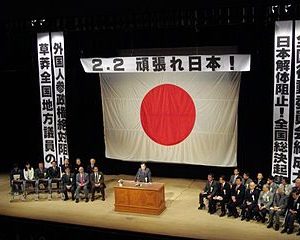 It was into this climate that the Takaichi administration emerged. Support for the administration was boosted by its symbolism as the first female prime minister in constitutional history, its tough rhetoric abroad, and its economic measures, which are believed to reach the people of Japan. Since taking office, support has been enthusiastic and widespread. Novelty can be seen as hope, and firmness as reassurance. However, this enthusiasm also awakens other premonitions. Passionate support coupled with a "longing for a strong leader" often leads to a fascist social mood. When frustration and anxiety call for an outlet, the masses favor strictness and snap decisions. Decisions are therefore chosen over debate, speeches over deliberation, and exclusion over mutual recognition.
Modern Japan has twice repeated the pattern of "starting from the bottom, rising to prominence, and then collapsing." The rapid growth of the nation's power after the Meiji Restoration was built on the "fake modernity" of the Imperial Constitution, while the war of the Showa era expanded as a result of the expansion of pro-imperial and patriotic ideology, leading to defeat. After the war, Japan experienced rapid economic growth and a bubble economy under the orderly design of pro-American conservatives, and after the collapse of the economy, a long period of stagnation once again saw a growing desire for a "strong leader." What is needed at this point is the insight to calmly see through history's replay. Enthusiasm is tempting, but historical memory is a tool for maintaining composure.
Section 1: The Three-Phase Structure of Modern Japan
A broad overview of the past 150 years of modern Japan reveals a long-term stagnation at its base, upon which the frenzy of fascist politics rose, ultimately resulting in collapse. In the early Meiji period, under pressure from both internal and external threats, the outward appearance of a modern state was hastily created, with national resources concentrated on the military and industry. While there was a breath of freedom and civil rights, the institutionalization of these rights was delayed, and top-down modernization left civil society below behind. Then, with the establishment of the Imperial Constitution, the formal production of constitutionalism and the actual strengthening of the Emperor's supreme power ran side by side. A dual structure was born in which modernity was merely a decoration, while governance remained pre-modern.
During the wartime Showa era, this dual structure exploded in ideological terms. Conscription laws and the Imperial Rescript on Education made loyalty and dedication common sense, the boundaries between the state and the individual blurred, and extreme dedication like kamikaze attacks was elevated to a virtue. The Imperial Rule Assistance Association encouraged shouts of "One Hundred Million Fireballs," defeat was rephrased as "redeemability," and spiritualism masked real shortcomings. Enthusiasm breeds homogenization, and homogenization breeds a cessation of thought. The war ended in defeat, and the country was reduced to ashes. The collapse was not sudden; it was the result of a long period of deception.
Postwar reconstruction proceeded under the symbolic emperor system and the Japan-US Security Treaty, with the political and economic order continually reorganized as the mainstream shifted from Yoshida to Ikeda, from Ikeda to Tanaka, from Tanaka to Takeshita, and finally to the Seiwa Kai, which followed in Kishi's footsteps. Rapid economic growth gave rise to stories of distribution, while the bubble gave rise to stories of euphoria. However, the long-term stagnation that followed its collapse brought institutional fatigue to the surface, and weariness with "remaining the same" transformed into a desire for "someone who will bring about change all at once." At this point, the rhythm of "bottom, rise, collapse" begins to play again. At a time when calm is needed to encourage a fresh start from the bottom, if enthusiasm takes the lead, the shadow of collapse becomes darker.
Section 2: The Imperial Constitution and "Fake Modernity"
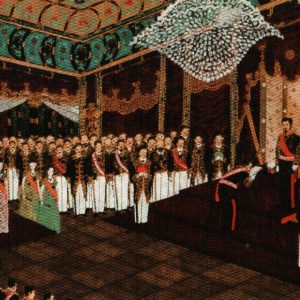 The Imperial Constitution was created as a certificate to rank alongside the great powers, but its framework was designed to absolutize the Emperor's supreme power and suppress civil rights. The establishment of a parliament appears at first glance to be a modern system of transparency and consensus building. However, its initial role was more as a financial device for raising funds for war. Foreign wars require huge amounts of money. Internal taxes alone are not enough, and in order to issue foreign bonds on the London market, it was necessary for the budget and income and expenditure system to be made visible through parliament. In other words, parliament was not opened for the people, but rather to gain the trust of external capital.
The independence of supreme command is at the heart of this pseudo-modern era. Article 11 of the Imperial Constitution, which stipulates that "The Emperor shall have supreme command of the Army and Navy," separated the military from the political system of governance and made it possible to make direct petitions to the Emperor. This created a strange situation in which the Chief of Staff and the Chief of the Naval General Staff could bypass the Cabinet and report to the Emperor, while the Cabinet was responsible and unable to participate in decision-making. The active-duty military officer system further subordinated politics to the military, making it impossible to form a cabinet unless the military provided ministers. The controversy over "interference with supreme command" that erupted during the signing of the London Naval Treaty exposed a structure in which diplomacy was subordinate to the military.
The suppression of civil rights movements and the strengthening of institutions reinforced each other behind the false facade of modernity. The Chichibu Konminto uprising was a desperate cry from the hardships of life, but the state sent in the military to suppress it, narrowing the path for people to participate in politics. Following the Takebashi Incident, which saw the Imperial Guard artillerymen's discontent explode, the Imperial Rescript to Soldiers and Sailors established absolute obedience as a virtue. The ethic of obedience eventually transformed into an ethic of dedication, and individual lives became subordinate to the goals of the state. Modern institutions became devices for waging modern wars without nurturing modern citizens.
Section 3: Expansion of Respect for the Emperor and Patriotic Ideology
Until the Edo period, the Emperor was a distant symbol for the common people. However, with the Conscription Act and the Imperial Rescript on Education, the Emperor became a familiar axis of ethics. Schools taught loyalty and filial piety, homes displayed scrolls of the Imperial Rescript, and youth groups and veterans' associations organized local rituals. As loyalty became ingrained as a code of conduct in life, war became a moral obligation. When a crisis arose, people were called upon to "serve the Emperor with volunteerism," and resistance was crushed.
Kamikaze attacks are the ultimate form of this ethic. When the value that an individual's life is dedicated to the community by dying beautifully is established, strategy is reverted to spiritualism. The phrase "infinite spiritual strength" functions as a magic wand to compensate for real-world shortcomings, and lack of supplies and logistical breakdowns are explained as a lack of spiritual strength. Ethics supplement systems, but when ethics replace systems, decision-making that ignores real-world constraints becomes habitual. Respect for the emperor and patriotism were orders that were supposed to contribute to the survival of the nation. However, overly inflated ethics made the nation vulnerable. When devotion is replaced by rationality, the nation heads toward collapse.
Section 4: The War with the United States, the Completion and Collapse of the Meiji System
In 1941, Japan decided to go to war with the United States. Despite the Akimaru Institute's analysis that defeat was inevitable, spiritualism and passion prevailed. The string of defeats—Guadalcanal, Imphal, Leyte, Okinawa—was rephrased as a "reversal," and the public was cut off from the reality of victory or defeat. The Imperial Rule Assistance Association's propaganda continued to provide oxygen to maintain enthusiasm, while newspapers and radio used exaggeration and silence as weapons. Rational judgment was swept away by spiritualism as a political culture, and the military's inherent decision-making structure came to dominate cabinet rule.
The war revealed the Meiji system in its final form. With the system of imperial supreme power, the system of independent command authority, the culture of an ethic of dedication, and the Imperial Rule Assistance Association's mobilization apparatus in full operation, its modern appearance was merely a necessary decoration. But at the same time, it also marked a trajectory of collapse. The flaws in the system are magnified in the extreme circumstances of war. In a structure in which political responsibility is dispersed and military responsibility is left hanging, it is difficult to rationally resolve defeat. Surrender was a realistic outcome, but it was also a structural necessity. The Meiji system was completed and ended with the war.
Section 5: Continuity into the Postwar Period
Defeat in the war did not mean the complete abolition of the system. The symbolic emperor system continued, and the Japan-US security arrangements became the backbone of order. In 1955, conservative parties merged to form the Liberal Democratic Party, and conservatives have remained at the heart of government ever since. Yoshida Shigeru's policy of light armament and emphasis on the economy led to Ikeda Hayato's income doubling plan, spreading the successful experience of distribution throughout society. The "100 million middle class" was a mixture of reality and fantasy, and people were content with the simple story that hard work would be rewarded.
Tanaka Kakuei's powerful politics spread infrastructure investment to every corner of the country: roads, ports, airports, dams... Physical growth was shared as a reality, and politics was understood as a "system for distributing profits." Takeshita Noboru's Keiseikai party continued this line, promoting economic-centered political management while maintaining a pro-China and multilateral diplomatic stance. However, a structure in which politics and economics are closely linked can also be a breeding ground for scandals. The Recruit scandal became an opportunity to question the distance between politics and capital.
The rise of the Seiwa Kai party symbolizes the shift from pro-American nationalist conservatives in the postwar era to pro-Americanism and market reform. Junichiro Koizumi's structural reforms, under the banner of postal privatization, promoted the redistribution of national wealth and the opening of markets. Shinzo Abe's long-term administration marked a watershed moment for postwar Japan, transforming it into a military power capable of waging war by accepting the right of collective self-defense. The "resoluteness" of the Takaichi administration is an extension of this trend.
Section 6: The Takaichi administration and the fascist mood
 Support for the Takaichi administration is based on a combination of three elements: symbolism, forcefulness, and immediate results. The uncharted territory of a female prime minister provided fresh air to voters tired of political inertia. Her tough words toward China and South Korea provided psychological relief in an era of geopolitical uncertainty. Her direct measures for people, such as her immediate response to fuel prices and energy costs, presented "easy-to-understand politics" to people who were impatient to wait for complex economic policies.
However, rapid enthusiasm often narrows the space for debate. Strong words garner strong support, but they also make dissenting opinions appear weak. When anticipation pervades society, an atmosphere of "move forward at all costs" short-circuits the consensus-building process and makes legitimate dissent visible as a "nuisance." Xenophobic discourse is a convenient tool for transforming global anxiety into domestic unity. Vibrancy functions as a substitute for complexity. Enthusiasm creates unity, but unity comes at the expense of diversity.
Politics is the art of coalitions and compromise, but enthusiasm disregards technique. Coalitions for the sake of numbers and coalitions for the sake of a story are similar but not the same. The former seeks consistency in policy, while the latter seeks consistency in emotion. When society begins to favor the latter, democracy retains its form but loses its substance. The faces remain the same, only the words change. When strong vocabulary abounds, weak facts become invisible. This is where a fascist mood lurks. Passion washes away the procedures in the chamber, and applause begins to replace votes.
Section 7: From Enthusiasm to Disillusionment: The Typical Trajectory of Fascism
History has been ruthless in assessing the sustainability of enthusiasm. The prewar Imperial Rule Assistance Movement evaporated the moment of defeat, and the postwar euphoria of "Japan is number one" faded with the collapse of the bubble economy. Enthusiasm depends on a simplification of the world view. The world is simple, we are right, and the enemy is wrong. Simplicity speeds up decision-making and strengthens unity. But the world is complex, interests conflict, and good and evil overlap. A political culture that cannot tolerate complexity is vulnerable to changes in reality.
Disillusionment is not the reversal of enthusiasm; it is a side effect of enthusiasm. Procedures skipped, risks overlooked, and expertise postponed due to enthusiasm send a bill with a delay. At that time, those who applauded the enthusiasm pass the bill on to politics, and politics becomes accountable. However, policies made in the midst of enthusiasm reduce the room for explanation. A politics that makes quick decisions, communicates quickly, and quickly gathers support is not suited to long explanations. A politics that lacks explanation becomes a politics of disillusionment. Enthusiasm attracts support, and disillusionment attracts distrust. Distrust turns into indifference, and political legitimacy erodes.
Section 8: The Structure of Drift and Information Defeat
A stagnant society also exhibits distinctive characteristics in the way information is handled. Prewar Imperial Headquarters announcements manipulated information about victory or defeat and controlled public perception. After the war, information management changed form and continued to function as a device supporting the national narrative. Television amplified stories of prosperity, newspapers amplified stories of stability, and advertising amplified stories of consumption. With the advent of the Internet, the supply of information became decentralized, and anyone could become a sender. Transparency was supposed to increase, but the reality is complicated. Decentralization decentralizes responsibility, and information with diluted responsibility drives emotions.
Modern social media is designed through algorithms to maximize reactions. Anger and fear spread, while calming facts are buried. People are surrounded by information that reinforces their beliefs, and they stop seeing different perspectives. This is the filter bubble, a breeding ground for division. Self-esteem stories like "Japan is amazing" make people feel good, while exclusionary stories like "They're dangerous" attract more allies. Political participation is on the rise, but the quality of that participation depends on emotional responses. Clicks and retweets from young people become voices, and voices become support. However, that support is gathered through empathy with the story rather than through scrutiny of information.
If information transparency is lost, society will once again fall victim to an informational defeat. Misinformation leads to poor policymaking, and oversimplification discards reality, amplifying conflict. Politics is forced to choose between riding on conflict or managing it. Riding on conflict increases support, while managing it decreases it. Short-term incentives lead to the former choice. In this way, the information environment supports political enthusiasm and weakens democratic deliberation. Weakening deliberation undermines trust in the system. When trust weakens, a performance of strength becomes a substitute. The performance of strength hides actual weakness. This is the structure of drift.
Section 9: The mechanism behind the bubble's euphoria and collapse
Financial liberalization in the 1980s created massive leverage in the Japanese economy. Revisions to the Foreign Exchange Law made capital movements easier, interest rate liberalization intensified competition among banks, and rising collateral valuations justified increased lending. During the period of yen appreciation following the Plaza Accord, policymakers moved to avoid a recession, and low interest rates and increased liquidity led to rising asset prices. Stock and real estate prices inflated due to the self-propagating effects of expectations. Rising prices led to increased lending, and more lending led to higher prices. The cycle lost equilibrium and was primed for collapse.
Collapse begins with a change in policy. When monetary tightening is introduced, the cycle of self-reinforcement reverses, with falling collateral values restricting lending, and reduced lending driving down prices. Bad loans eat away at bank balance sheets, narrowing the supply of credit. Private investment cools, wage growth halts, and inflation is suppressed, but deflation becomes entrenched. Financial liberalization required the redesign of institutional oversight and discipline in exchange for capital freedom. However, Japan's system was slow to redesign, and freedom turned into structural vulnerability. The interaction with external pressures cannot be overlooked. Domestic policy became subordinate to international exchange rate adjustments, and international considerations took precedence over domestic considerations. As a result, liberalization became both an engine of prosperity and an amplifier of collapse.
The euphoria of the bubble was fueled by a culture that preferred stories of prosperity over financial expertise. Securities TV stations praised high stock prices, magazines competed to introduce ways to double assets, and the streets were filled with an atmosphere of "Japan is on top of the world." The euphoria drowned out the director's warnings. When the collapse began, the backlash to the euphoria prioritized self-defense, investment stopped, consumption dwindled, and internal reserves increased. Companies chose safety over wage increases, and individuals chose to maintain stability over challenges. This marked the beginning of a long period of stagnation.
Section 10: A New Form of Information Defeat
The internet was expected to be a tool for democratizing information. Anyone could send information and anyone could learn. However, in reality, algorithmic selection and maximization of responses have become widespread. Social media prioritizes content that provokes strong reactions in order to increase user dwell time and increase advertising value. Anger, fear, envy, pride—these emotions are the fuel for diffusion. Quiet facts and complex analyses are less likely to burn. What is less likely to burn is less noticeable. What is less noticeable has no impact.
Filter bubbles trap users in a sea of homogeneous information. Like-minded people praise each other, while dissenting opinions are targeted for attack. Networks foster solidarity, but this solidarity also entails exclusion. As exclusion intensifies, political targets are simplified into "friends" and "enemies," and policy debates turn into judgments of good and evil. In Japan, self-respecting narratives such as "a Japan we can be proud of" are amplified by algorithms while xenophobic narratives such as "they are dangerous" run parallel. While social media has made young people's political participation visible, much of this participation is an extension of reactions to content and is supported by immediate responses rather than deliberation. Immediate responses generate momentum, which turns into support. However, momentum does not guarantee sustainability. When support is born from emotional reactions, fluctuations in policy are directly linked to fluctuations in support, making politics more susceptible to short-term fluctuations.
Prewar Imperial Headquarters announcements led to defeat due to centralized information control. Modern information defeat undermines the foundations of deliberation through emotional filtering of scattered information. From control to emotion. The form is different, but the outcome is similar. Society is drawn to a simplified view of the world and loses its tolerance for complex reality. A society that has lost its tolerance prefers strong narratives, and strong narratives attract strong leaders. When leaders project strength, support for the projection takes priority over reality. This weakens the process that is the foundation of democracy, and results become everything. Politics that shortcuts the process for the sake of results maintains support through short-term results, but undermines the long-term foundation.
Conclusion Modern Japan, comprised of three stages of a course yet to be chosen , is now approaching a critical point of replay. Secular stagnation has become the norm, the enthusiasm of pseudo-fascist politics is gaining in appeal, and the shadow of collapse is growing. Will history repeat itself? If so, what have we learned? The answer is not simple. But some clues are clear: do not restart the machinery of pseudo-modernity. do not replace rationality with an ethic of self-sacrifice. do not short-circuit the governance process. maintain information transparency and resist the temptation of algorithms. accompany financial liberalization with a redesign of oversight, and loosen dependence on external pressure with intrinsic discipline. strong institutions over strong words; deliberation over snap decisions; responsibility over pride. A society that chooses these things is less likely to be swayed by enthusiasm.
The Takaichi administration's passion is also a response to the frustration in society. If that frustration is ignored, the passion will erupt in a different form. This is why calm dialogue and concrete improvements are necessary. Ease the burden of living, sustainably raise wages, and reduce anxiety about the future. Openly discuss the reality of security and do not narrow diplomatic options. Rather than placing the line between friend and foe at the center of politics, place common challenges at the center. Improve the quality of information, participation, and process. Democracy takes effort. We need to value putting in effort again. This will be the first step toward ending our drift.
Enthusiasm is quick to acquire. Calmness takes time. But calmness, chosen over time, is resistant to collapse. Japan has twice experienced collapse as a result of deception and enthusiasm. To avoid a third time, what is needed at this very moment is the will to resist the temptation to repeat the same thing. The future is not a product of chance. It is a series of choices. The path to stop the drift lies beyond strong narratives. The choice is ours. In order to make that choice, let us begin by discerning: the temptations inherent in enthusiasm and the costs lurking in its shadow. Then, having discerned these, let us choose to walk the more difficult path.